Category: Kitchen & Meal Prep

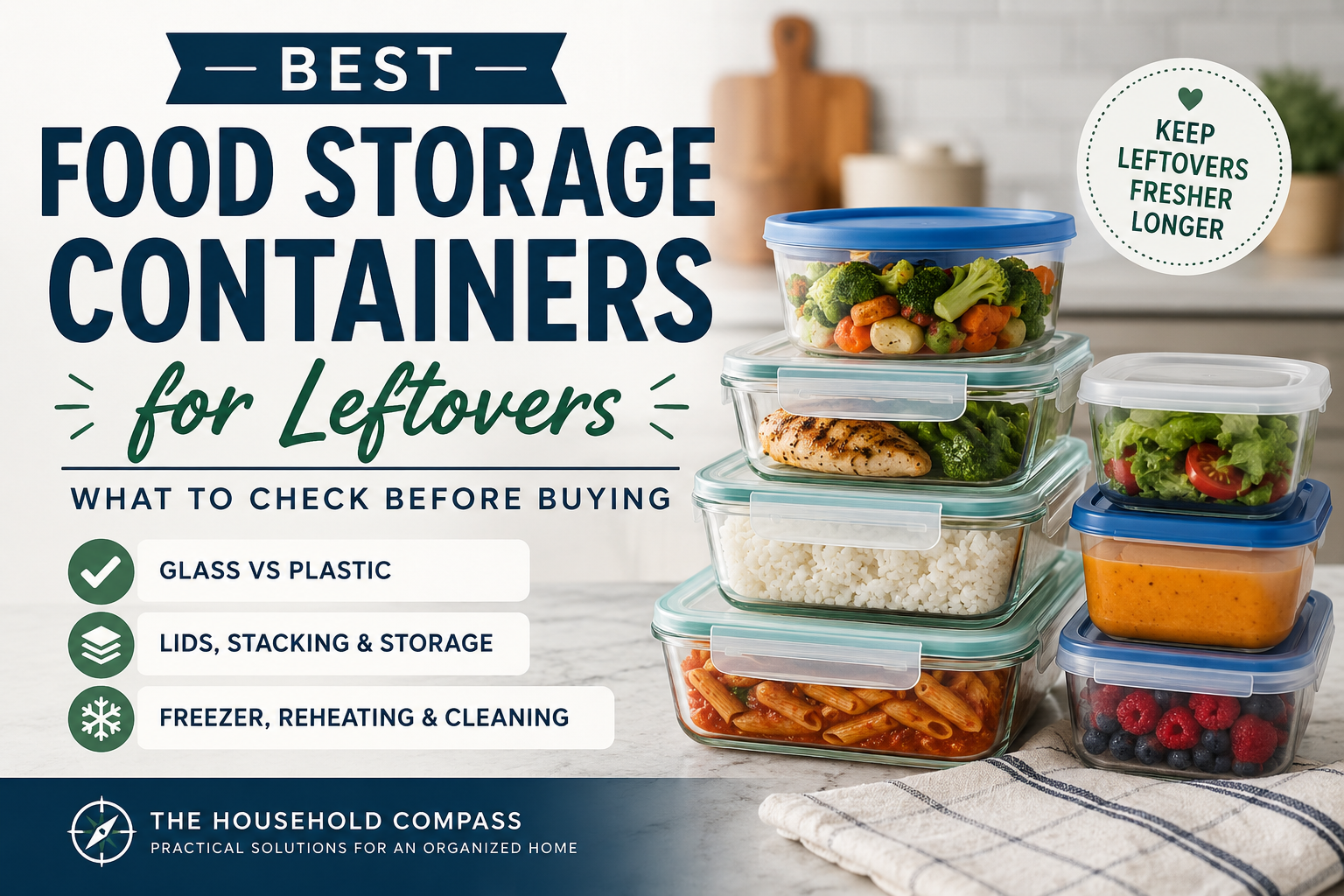
  • Best Food Storage Containers for Leftovers: What to Check Before Buying

    Best Food Storage Containers for Leftovers: What to Check Before Buying

    Kitchen & Meal Prep Buying Guide

    Best Food Storage Containers for Leftovers: 8 Sets Compared

    The right container system should make leftovers easier to see, store, reheat, freeze, pack, and organize—not create more lid clutter.

    This guide compares eight glass and plastic options by lid design, leak resistance, stacking, useful sizes, cleaning, appliance guidance, portability, and cabinet fit.

    Affiliate disclosure: Some links may be affiliate links. The Household Compass may earn a commission from qualifying purchases at no extra cost to you. Product prices, availability, included sizes, materials, care instructions, appliance compatibility, and retailer policies can change, so verify current details before purchasing or using any container.

    Quick Picks by Household Routine

    Choose by how the containers will actually be used. The advertised piece count normally includes both container bases and lids.

    Best Overall Glass

    Rubbermaid Brilliance Glass Set

    Best for clear refrigerator storage, saucy leftovers, reheating, and households that want locking vented lids.

    Main advantage: Clear glass bases, modular stacking, and secure locking lids make it a versatile all-around system.
    Check first: Glass is heavy, and the base and lid have different oven and microwave instructions.
    Check Rubbermaid Brilliance Glass at Target
    Best Locking Glass Value

    Pyrex FreshLock Glass Set

    Best for leftovers and packed meals when locking tabs and compact nesting are priorities.

    Main advantage: Four-tab lids, glass bases, and write-and-erase lid labels support refrigerator and meal-prep routines.
    Check first: Locking tabs and seals create more components to inspect and clean.
    View Pyrex FreshLock Set
    Best Temperature Flexibility

    OXO Smart Seal Glass Set

    Best for households that regularly move meals between freezer, refrigerator, microwave, and oven.

    Main advantage: Borosilicate glass, locking tabs, and removable silicone gaskets support broad food-storage use.
    Check first: Follow current temperature instructions and reinstall removable gaskets correctly after cleaning.
    View OXO Smart Seal Glass Set
    Best Simple Glass

    Pyrex Simply Store Meal Prep Set

    Best for repeated medium-size portions and straightforward refrigerator or freezer meal preparation.

    Main advantage: Five matching rectangular glass containers reduce size-matching decisions.
    Check first: Press-on lids are simpler than locking tabs but may not suit liquid-heavy transportation.
    View Pyrex Simply Store Set
    Best Modular Budget System

    IKEA 365+ Glass Container System

    Best for small kitchens and shoppers who want to build a set one useful size at a time.

    Main advantage: Individual bases and compatible lids let you avoid buying unwanted sizes.
    Check first: Confirm the correct lid, shape, capacity, and article combination before purchasing.
    View IKEA 365+ Glass Container
    Best Lightweight Clear

    Rubbermaid Brilliance Plastic

    Best for packed lunches, family outings, work meals, and clear storage without glass weight.

    Main advantage: Clear stackable plastic combines visibility with easier transportation.
    Check first: Review the exact set, included sizes, and current reheating guidance before buying.
    Explore Rubbermaid Brilliance Plastic
    Best for Lid Organization

    Rubbermaid EasyFindLids Vented Set

    Best when loose lids and mismatched cabinet storage are the main household frustration.

    Main advantage: Compatible lids snap together and attach to container bases during storage.
    Check first: Plastic can stain or retain odors sooner than glass, especially with strongly colored foods.
    View Rubbermaid EasyFindLids Set
    Best Premium Design

    Bentgo Signature Glass Set

    Best for polished meal preparation, serving, top-down visibility, and households avoiding plastic container bodies and lids.

    Main advantage: Borosilicate glass containers and silicone-framed tempered-glass lids create a distinctive premium system.
    Check first: Review total weight, stack height, steam-valve care, and current appliance instructions.
    View Bentgo Signature Glass Set

    Food Storage Container Comparison

    Use this table to narrow the material and lid style before opening a product page. Verify the base, lid, gasket, and appliance instructions separately.

    Product Best For Material Lid Style Main Advantage Main Caution Product Link
    Rubbermaid Brilliance Glass Saucy leftovers, visibility, reheating Glass base with plastic lid Locking and vented Clear, secure, modular storage Heavy; base and lid have different heat rules Check at Target
    Pyrex FreshLock Leftovers and packed meals Glass base with plastic lid Four locking tabs Secure closure and lid labels Tabs and seals require careful cleaning View at Pyrex
    OXO Smart Seal Glass Freezing, reheating, and broad use Borosilicate glass Locking tabs with removable gasket Temperature flexibility and removable seal Follow temperature and gasket instructions View at OXO
    Pyrex Simply Store Repeated meal-prep portions Tempered glass Press-on plastic lid Five matching rectangular containers Not the strongest liquid-transport choice View at Pyrex
    IKEA 365+ Glass Custom systems and small kitchens Heat-resistant glass Snap-lock plastic lid Buy only the sizes needed Match the correct base and lid View at IKEA
    Rubbermaid Brilliance Plastic Lunches and transportation Clear plastic Locking and vented Visibility without glass weight Confirm exact set and care guidance Explore at Rubbermaid
    Rubbermaid EasyFindLids Cabinet and lid organization Plastic Vented lids that attach during storage Easier lid matching May stain or hold odors sooner than glass View at Rubbermaid
    Bentgo Signature Glass Meal prep, serving, and premium design Borosilicate glass with glass lids Silicone-sealed vented lid Top-down visibility and plastic-free storage surfaces Check weight, valve care, and stack height View at Bentgo

    Glass vs. Plastic Food Storage Containers

    Neither material is best for every household. The better choice depends on reheating, weight, transportation, stain resistance, breakage risk, cabinet space, and price.

    Choose glass when:

    • Leftovers are reheated frequently.
    • Stain and odor resistance matter.
    • Clear refrigerator visibility is important.
    • Containers may move from storage to serving.
    • Extra weight and breakage risk are manageable.

    Choose plastic when:

    • Lunches and meals are carried regularly.
    • Low weight matters more than heat flexibility.
    • Break resistance is important around children or travel.
    • Efficient nesting and lower upfront cost are priorities.
    • You are comfortable following plastic care guidance.
    Practical compromise: Many households use glass for refrigerator leftovers and reheating, then keep a smaller lightweight plastic system for packed lunches, travel, and situations where breakage is a concern.

    Food Storage Container Buying Checklist

    A large set can still be a poor fit when the sizes, lids, shapes, or storage footprint do not match the household routine.

    1. Count container bases

    A 20-piece package may contain only 10 containers because the lids are included in the advertised total.

    2. Review every capacity

    Choose sizes that match normal leftovers, meal portions, sauces, side dishes, and family servings.

    3. Compare lid systems

    Review locking tabs, press-on lids, vents, removable gaskets, attachable lids, and replacement availability.

    4. Measure refrigerator space

    Check shelf depth and height, especially when containers will be stacked while full.

    5. Measure cabinet space

    Confirm that empty bases nest efficiently and that lids have a realistic storage location.

    6. Check each component

    The base, lid, gasket, vent, and locking tabs may have different dishwasher, microwave, freezer, or oven instructions.

    7. Separate airtight from leakproof

    Do not assume one claim guarantees the other. Review the exact manufacturer wording before carrying liquids.

    8. Limit incompatible systems

    One or two consistent systems are usually easier to stack, match, clean, and replace than many unrelated brands.

    Detailed Picks by Use Case

    Each product solves a different storage problem. Start with the routine, then verify current included sizes and care instructions.

    Best Overall Glass

    Rubbermaid Brilliance Glass Food Storage Set

    This is the strongest all-around choice for households that want glass bases, clear visibility, locking lids, modular stacking, and a vented reheating routine.

    • Best for: Sauces, curries, pasta, soups, vegetables, and common refrigerator leftovers
    • Main advantage: Secure locking lid system with clear modular storage
    • Main drawback: The set is heavier than plastic alternatives
    • Care warning: Verify the separate instructions for the glass base and plastic lid before microwave or oven use
    Check Rubbermaid Brilliance Glass at Target
    Best Locking Glass Value

    Pyrex FreshLock Glass Storage Set

    This option fits households that want locking glass storage for leftovers, work meals, freezer organization, and compact nesting.

    • Best for: Packed meals and refrigerator leftovers
    • Main advantage: Four locking tabs and label areas on the lids
    • Main drawback: Tabs and seals require more cleaning attention than a simple lid
    • Fit warning: Review the included capacities rather than judging value by the total piece count
    View Pyrex FreshLock Set
    Best Temperature Flexibility

    OXO Good Grips Smart Seal Glass Set

    This is a useful choice for households that regularly freeze, refrigerate, reheat, and serve meals from the same container system.

    • Best for: Freezer meals, reheating, leftovers, and meal preparation
    • Main advantage: Borosilicate glass and removable silicone gaskets
    • Main drawback: Removable seals add a part that must be cleaned and reinstalled correctly
    • Care warning: Follow current temperature-transition and lid instructions
    View OXO Smart Seal Glass Set
    Best Simple Glass

    Pyrex Simply Store Meal Prep Rectangular Set

    Five matching medium-size rectangular containers simplify portioning and stacking when repeated meal-prep servings are more useful than a mixed-size set.

    • Best for: Repeated lunches, meal-prep portions, and refrigerator organization
    • Main advantage: Matching rectangular containers reduce lid and size confusion
    • Main drawback: Press-on lids may not be the best choice for transporting liquids
    • Fit warning: Confirm that repeated 3-cup containers suit your normal portions
    View Pyrex Simply Store Set
    Best Modular Budget System

    IKEA 365+ Glass Food Container System

    This modular format lets shoppers build a consistent system gradually instead of buying a large boxed set with several unwanted sizes.

    • Best for: Small kitchens, budget control, and replacing individual pieces
    • Main advantage: Buy only the shapes and capacities the household uses
    • Main drawback: The base and lid may be separate components that must be matched carefully
    • Care warning: The glass base and plastic lid have different oven and heating instructions
    View IKEA 365+ Glass Container
    Best Lightweight Clear

    Rubbermaid Brilliance Plastic Containers

    This system offers the clear appearance and locking-lid style associated with Brilliance without the carrying weight of glass.

    • Best for: Work lunches, family outings, refrigerator visibility, and transportation
    • Main advantage: Lightweight clear containers with modular stacking
    • Main drawback: Plastic may stain, scratch, or retain odors sooner than glass
    • Care warning: Check the exact product configuration and current microwave guidance
    Explore Rubbermaid Brilliance Plastic
    Best for Lid Organization

    Rubbermaid EasyFindLids Vented Container Set

    This is the most practical option when the main problem is loose lids. Compatible lids are designed to snap together and attach to bases during storage.

    • Best for: Cluttered cabinets and households that frequently lose matching lids
    • Main advantage: Lid-to-lid and lid-to-base storage system
    • Main drawback: Plastic can stain or retain odors with repeated use
    • Care warning: Clean the built-in vents and verify current reheating instructions
    View Rubbermaid EasyFindLids Set
    Best Premium Design

    Bentgo Signature Glass Food Storage Set

    This premium system uses glass containers and silicone-framed tempered-glass lids for top-down visibility, serving, and polished meal preparation.

    • Best for: Meal prep, visible refrigerator storage, serving, and premium design
    • Main advantage: Glass lid panels, steam valves, and four useful rectangular sizes
    • Main drawback: The complete system is heavier and typically costs more than basic alternatives
    • Care warning: Review steam-valve, seal, dishwasher, microwave, freezer, and oven guidance
    View Bentgo Signature Glass Set

    Common Food Storage Container Mistakes

    Counting lids as containers

    Compare the actual number of container bases, not only the advertised piece count.

    Buying too many tiny sizes

    Small containers can be useful for sauces and partial portions, but too many create clutter and rarely solve the main leftover-storage problem.

    Ignoring lid storage

    A container system is not organized when matching lids are difficult to find, stack, or replace.

    Assuming airtight means spillproof

    Review the manufacturer’s current wording before carrying soups, sauces, curries, or other liquids.

    Mixing too many incompatible systems

    One or two consistent systems are usually easier to maintain than drawers and cabinets filled with unrelated bases and lids.

    Ignoring shelf and cabinet height

    Measure filled stacking height in the refrigerator and empty nesting height in the cabinet.

    Using one care rule for every component

    The base, lid, gasket, vent, and locking tabs may have different dishwasher, microwave, freezer, and oven limits.

    A Simple Leftover-Container Organization System

    1. Remove damaged pieces: Discard cracked bases, warped lids, damaged seals, and containers without matches.
    2. Keep one primary system: Consistent shapes and lids reduce matching time.
    3. Store lids vertically: Use a shallow bin, divider, or dedicated lid section.
    4. Nest only compatible bases: Do not force unrelated containers together.
    5. Use rectangular shapes strategically: They often use shelf and cabinet space efficiently.
    6. Group small containers: Keep sauce and snack sizes together instead of scattering them through the cabinet.
    7. Move older leftovers forward: Visibility is useful only when the refrigerator routine supports it.
    8. Recheck the system monthly: Remove pieces that no longer have a matching lid or regular use.

    For the surrounding kitchen-storage system, also compare kitchen drawer organizers for small kitchens. Coordinating containers, lids, labels, measuring tools, and lunch-packing utensils can reduce clutter across several kitchen zones.

    Which Container Type Fits Your Routine?

    For Reheating

    Start with glass and verify current base, lid, microwave, and oven instructions.

    For Packed Lunches

    Choose lightweight plastic or compact locking glass after checking weight and leak claims.

    For Small Kitchens

    Prioritize rectangular shapes, efficient nesting, repeated useful sizes, and organized lids.

    For Soups and Sauces

    Use a manufacturer-described leakproof system and test the closure before transportation.

    For Freezer Meals

    Verify freezer guidance, avoid overfilling, and allow appropriate expansion space.

    For Meal Prep

    Repeated medium-size containers can be easier to portion, stack, wash, and replace.

    Frequently Asked Questions

    Are glass or plastic containers better for leftovers?

    Glass is often better for visibility, odor resistance, stain resistance, and reheating. Plastic is lighter, less breakable, and easier to carry. Many households use both for different routines.

    What container sizes are most useful for leftovers?

    Medium rectangular containers are useful for meals, side dishes, vegetables, and partial family portions. Add only a few small sizes for sauces, snacks, and partial ingredients.

    Are locking lids always leakproof?

    No. Review the current manufacturer claim for the exact product and test the seal before transporting liquid-heavy food.

    Can containers go directly from the freezer to a microwave or oven?

    Only when the manufacturer specifically allows that use. The base and lid can have different instructions, and temperature transitions may require special care.

    Are round or rectangular containers better?

    Rectangular containers often use shelf space efficiently. Round containers can be convenient for stirring, mixing, and some leftovers. Choose the shape that fits the refrigerator and the food you store most often.

    How many food storage containers does a household need?

    Start with enough for two or three days of normal leftovers and meal preparation. A smaller consistent system is usually easier to manage than a large set filled with rarely used sizes.

    How should food-storage lids be organized?

    Store lids vertically in a shallow bin, divider, or dedicated lid organizer. Group them by system and remove lids that no longer have matching bases.

    Related Household Guides

    Continue improving the kitchen, lunch-packing, and family meal routine with these connected guides.

    Final Picks by Need

    • Best overall glass set: Rubbermaid Brilliance Glass
    • Best locking glass value: Pyrex FreshLock
    • Best for temperature flexibility: OXO Smart Seal Glass
    • Best simple meal-prep set: Pyrex Simply Store
    • Best modular budget system: IKEA 365+ Glass
    • Best lightweight clear option: Rubbermaid Brilliance Plastic
    • Best for lid organization: Rubbermaid EasyFindLids
    • Best premium glass-lid design: Bentgo Signature Glass

    Choose the material and lid system that match the routine, then verify current sizes, care instructions, appliance compatibility, and retailer details before purchasing.

    Return to Quick Picks
  • Best Kitchen Drawer Organizers for Small Kitchens: What to Check Before Buying

    Kitchen & Meal Prep Buying Guide

    Best Kitchen Drawer Organizers for Small Kitchens: 6 Options Compared

    A useful drawer organizer should fit the drawer, match the utensils you actually use, and make cooking, lunch packing, and cleanup easier.

    This guide compares six organizer styles by layout, material, cleaning, expandability, tool fit, and the main tradeoff to check before buying.

    Affiliate disclosure: Some links may be affiliate links. The Household Compass may earn a commission from qualifying purchases at no extra cost to you. Product prices, availability, dimensions, materials, care instructions, and retailer policies can change, so verify current details before purchasing.

    Quick Picks by Drawer Problem

    Choose the use case that most closely matches your drawer. Measure the inside width, depth, and height before opening the retailer page.

    Best Overall

    OXO SoftWorks Expandable Kitchen Tool Drawer Organizer

    Best for a mixed drawer containing cooking tools, small gadgets, and irregular utensils.

    Main advantage: Expandable open storage and adjustable dividers provide more flexibility than a basic flatware tray.
    Check first: Confirm the full footprint and whether the layout suits your longest or bulkiest tools.
    Check OXO SoftWorks at Walmart
    Budget Pick

    Brightroom Expandable Utensil Drawer Organizer

    Best for basic forks, spoons, knives, and everyday flatware organization on a lower budget.

    Main advantage: A straightforward expandable format for common flatware categories.
    Check first: Small compartments may not solve clutter from bulky cooking tools or gadgets.
    View Brightroom Organizer at Target
    Best for Long Tools

    OXO Expandable Long Tool Organizer

    Best for spatulas, tongs, whisks, serving spoons, and other long-handled cooking utensils.

    Main advantage: Open length and adjustable sections are better suited to long utensils than small flatware slots.
    Check first: This is less useful for a drawer containing mostly forks, spoons, and knives.
    View OXO Long Tool Organizer
    Flatware + Tools

    The Container Store Expandable Flatware & Utensil Tray

    Best when one wider drawer must hold eating utensils and some larger kitchen tools together.

    Main advantage: Combines flatware organization with extra space for broader utensil storage.
    Check first: The expanded tray may be too wide for a narrow small-kitchen drawer.
    View Expandable Flatware Tray
    Best Wood Look

    Rowan Expandable Acacia Utensil Organizer

    Best for households that prefer a warmer wood-style organizer rather than a plastic tray.

    Main advantage: A more furniture-like appearance inside the drawer.
    Check first: Review current moisture and cleaning instructions before using it in a spill-prone drawer.
    View Acacia Utensil Organizer
    Best for Stacked Utensils

    OXO Expandable Utensil Drawer Organizer

    Best for smaller drawers where stacked flatware sections can conserve width.

    Main advantage: Makes more efficient use of limited drawer width when flatware is the main problem.
    Check first: Confirm drawer height and decide whether stacked access feels convenient for daily use.
    View OXO Stacked Utensil Organizer

    Kitchen Drawer Organizer Comparison

    Use this table to narrow the format before opening a product page. Exact dimensions and care directions should always be confirmed with the current retailer or manufacturer listing.

    Product Best For Style Main Drawback to Check Product Link
    OXO SoftWorks Expandable Kitchen Tool Organizer Mixed cooking tools and irregular utensils Plastic, expandable, adjustable dividers May use more drawer space than a basic flatware tray Check at Walmart
    Brightroom Expandable Utensil Organizer Budget flatware organization Plastic, expandable Less suitable for bulky tools and gadgets View at Target
    OXO Expandable Long Tool Organizer Spatulas, tongs, whisks, and serving tools Long-tool layout with adjustable sections Not designed primarily for flatware-only drawers View at OXO
    Expandable Flatware & Utensil Tray Flatware plus larger kitchen utensils Wider expandable tray May be too wide after expansion View at The Container Store
    Rowan Expandable Acacia Organizer Warm wood-look kitchen organization Expandable acacia-style organizer May require more careful moisture and spill management View at The Container Store
    OXO Expandable Utensil Drawer Organizer Stacked flatware in narrower drawers Stacked utensil sections Requires enough drawer height and comfort with stacked access View at The Container Store

    Measure These 4 Things Before Buying

    The most common failure is choosing an organizer from a product photo without checking the inside of the actual drawer.

    1. Inside width, depth, and height

    Measure the usable interior, not the cabinet face. Check both the minimum and maximum width of an expandable organizer.

    2. Your longest and widest tools

    Measure spatulas, tongs, whisks, peelers, serving spoons, and bulky handles instead of assuming every tool fits a standard slot.

    3. Daily utensil volume

    Count the forks, spoons, knives, kids utensils, measuring tools, and lunch-packing items used most often.

    4. Clearance when the drawer closes

    Stacked caddies, tall dividers, and overloaded compartments can scrape or jam even when the tray fits the drawer footprint.

    What Matters Most in a Small Kitchen

    The best organizer is not necessarily the one with the most compartments. It is the one that reduces friction in the routine your household repeats every day.

    Match the organizer to the drawer’s main job

    A flatware tray works well for forks, spoons, and knives. A long-tool organizer is more useful for spatulas, tongs, whisks, and serving tools. A mixed drawer may need open areas or adjustable dividers instead of many narrow compartments.

    Prioritize the items used every day

    Keep daily flatware, cooking tools, and lunch-packing items easy to reach. Move specialty gadgets or duplicate utensils to a less accessible drawer, cabinet, or storage bin.

    Plan for crumbs and spills

    Kitchen drawers collect crumbs and small spills. Plastic trays may be easier to wipe, while wood-style organizers can require closer attention to current care instructions and moisture guidance.

    Do not organize around appearance alone

    Small compartments can look neat in product photos but fail when handles are wide, tools are irregular, or the drawer contains several unrelated categories.

    Connect drawer organization to food storage

    If the drawer is part of a broader meal-prep or leftover-storage problem, also compare food storage containers for leftovers. Coordinating containers, lids, measuring tools, labels, and lunch-packing supplies can reduce clutter across multiple kitchen zones.

    Detailed Picks by Use Case

    Each option below solves a different drawer problem. The decision should begin with what the drawer holds, not which organizer looks best in isolation.

    Best Overall

    OXO SoftWorks Expandable Kitchen Tool Drawer Organizer

    This is the strongest general-purpose choice for a mixed drawer containing spatulas, peelers, small gadgets, clips, and irregular tools. Adjustable sections make it more adaptable than a fixed flatware tray.

    • Best for: Mixed cooking tools, busy kitchens, and lunch-prep drawers
    • Main advantage: Flexible open storage with adjustable sections
    • Main drawback: It may occupy more width than a compact flatware tray
    • Fit warning: Check the full footprint and the length of your largest tools
    Check OXO SoftWorks at Walmart
    Budget Pick

    Brightroom Expandable Utensil Drawer Organizer

    This option makes the most sense when the drawer problem is basic flatware clutter rather than bulky cooking tools. It provides an expandable layout without adding unnecessary complexity.

    • Best for: Forks, spoons, knives, and budget-focused organization
    • Main advantage: Simple expandable storage for common flatware
    • Main drawback: Small compartments may not fit gadgets or broad handles
    • Fit warning: Confirm compartment size, drawer height, and expanded width
    View Brightroom Organizer at Target
    Best for Long Tools

    OXO Expandable Long Tool Organizer

    Choose this format when long-handled utensils are the main source of clutter. Spatulas, tongs, whisks, and serving spoons need open length more than small flatware compartments.

    • Best for: Long cooking and serving utensils
    • Main advantage: Better alignment with long-tool dimensions
    • Main drawback: Less efficient for a flatware-only drawer
    • Fit warning: Measure the longest utensil and confirm divider placement
    View OXO Long Tool Organizer
    Best for Flatware + Tools

    The Container Store Expandable Flatware & Utensil Tray

    This wider format is useful when one drawer must handle both eating utensils and a smaller group of cooking tools. It can prevent the need to divide those items across two drawers.

    • Best for: Mixed flatware and utensil storage
    • Main advantage: Separate flatware areas plus broader side storage
    • Main drawback: The expanded layout may be too wide for narrow drawers
    • Fit warning: Check the width at full expansion and the drawer depth
    View Expandable Flatware Tray
    Best Wood Look

    Rowan Expandable Acacia Utensil Organizer

    This option suits households that prefer a warmer, more finished appearance inside the drawer. The visual benefit comes with a greater need to follow current care and moisture guidance.

    • Best for: Warm kitchen finishes and appearance-focused organization
    • Main advantage: Wood-style appearance rather than standard plastic
    • Main drawback: May require more care around moisture and spills
    • Fit warning: Verify drawer dimensions, finish, and cleaning instructions
    View Acacia Utensil Organizer
    Best for Stacked Utensils

    OXO Expandable Utensil Drawer Organizer

    Stacked utensil sections can save width in a small drawer with a large amount of flatware. This style is most useful when the drawer has enough height and stacked access does not slow the household down.

    • Best for: Narrow drawers and flatware-heavy households
    • Main advantage: Uses vertical organization to conserve width
    • Main drawback: Not every utensil remains fully visible at once
    • Fit warning: Confirm drawer height and comfort with stacked access
    View OXO Stacked Utensil Organizer

    Common Drawer Organizer Mistakes

    Buying before measuring

    Expandable organizers still require a minimum drawer size. Measure the interior width, depth, and height before choosing a product.

    Choosing too many small compartments

    Small sections can fail when the drawer contains broad handles, peelers, measuring cups, kids utensils, or lunch-packing tools.

    Ignoring cleaning and removal

    An organizer that is difficult to lift, wipe, or reinstall can make routine cleaning more frustrating than the original clutter.

    Mixing unrelated categories

    Flatware, cooking tools, batteries, tape, junk-drawer items, and kids supplies can overwhelm even a well-designed tray. Give the drawer one main job whenever possible.

    Filling every available space

    Leaving a small amount of open room makes it easier to return tools to the correct section and adapt when the household routine changes.

    Small-Kitchen Drawer Setup Plan

    1. Remove everything: Clean the empty drawer and identify duplicates or rarely used tools.
    2. Group by routine: Separate daily flatware, long cooking tools, lunch-packing supplies, and specialty gadgets.
    3. Measure the groups: Note the longest handles, widest tools, and approximate utensil volume.
    4. Choose one primary layout: Flatware, long tools, mixed tools, wood look, or stacked storage.
    5. Move low-use items: Place specialty gadgets in a secondary drawer, cabinet, or storage bin.
    6. Recheck after one week: If tools keep landing in the wrong area, the layout does not match the real routine.

    If the drawer supports daycare or school lunch packing, also compare toddler lunch boxes, toddler snack containers, and toddler water bottles so the storage zone supports the complete packing routine.

    Frequently Asked Questions

    Are wood or bamboo-style drawer organizers better than plastic?

    Neither material is automatically better. Plastic is often easier to wipe, while wood-style organizers may provide a warmer appearance. Compare current care instructions, moisture guidance, drawer fit, and your normal cleaning routine.

    Are expandable drawer organizers worth it?

    They are useful when the drawer has enough width and the expanded area matches the utensils you own. They are less useful when the drawer is narrow or the added section does not solve the actual clutter problem.

    What should go in a small kitchen drawer organizer?

    Start with the items used most often: forks, spoons, knives, spatulas, tongs, peelers, measuring spoons, and small cooking tools. Move rarely used gadgets elsewhere when they make daily items harder to reach.

    How do I stop the utensil drawer from getting messy again?

    Keep the categories simple, avoid overfilling compartments, remove duplicates, and reassess the layout after a week of normal use. Repeated misplacement usually means the sections do not match the household routine.

    Should lunch-packing supplies go in the utensil drawer?

    Only when they are used daily and do not crowd the drawer. Kids utensils, labels, and small tools can fit near flatware, while bulky snack containers or lunch boxes generally need a separate cabinet or bin.

    Related Household Guides

    Continue organizing the kitchen and lunch-packing routine with these connected guides.

    Final Picks by Need

    • Best overall for mixed tools: OXO SoftWorks Expandable Kitchen Tool Drawer Organizer
    • Best budget flatware option: Brightroom Expandable Utensil Drawer Organizer
    • Best for spatulas and long tools: OXO Expandable Long Tool Organizer
    • Best for flatware plus cooking utensils: The Container Store Expandable Flatware & Utensil Tray
    • Best wood-look option: Rowan Expandable Acacia Utensil Organizer
    • Best for narrow, flatware-heavy drawers: OXO Expandable Utensil Drawer Organizer

    Measure first, choose the layout that matches the drawer’s main job, and verify current dimensions and care instructions before buying.

    Return to Quick Picks